MyBibliotheca Blog
Audio Notes: Record and Transcribe Your Thoughts About a Book

Audio Notes: Record and Transcribe Your Thoughts About a Book

3 minutes read

MyBibliotheca now lets you record audio notes on a book. Open a book, press record, say what you think, and the note is saved next to your written notes. If you would rather have it as text, one button turns it into an entry in your notes.

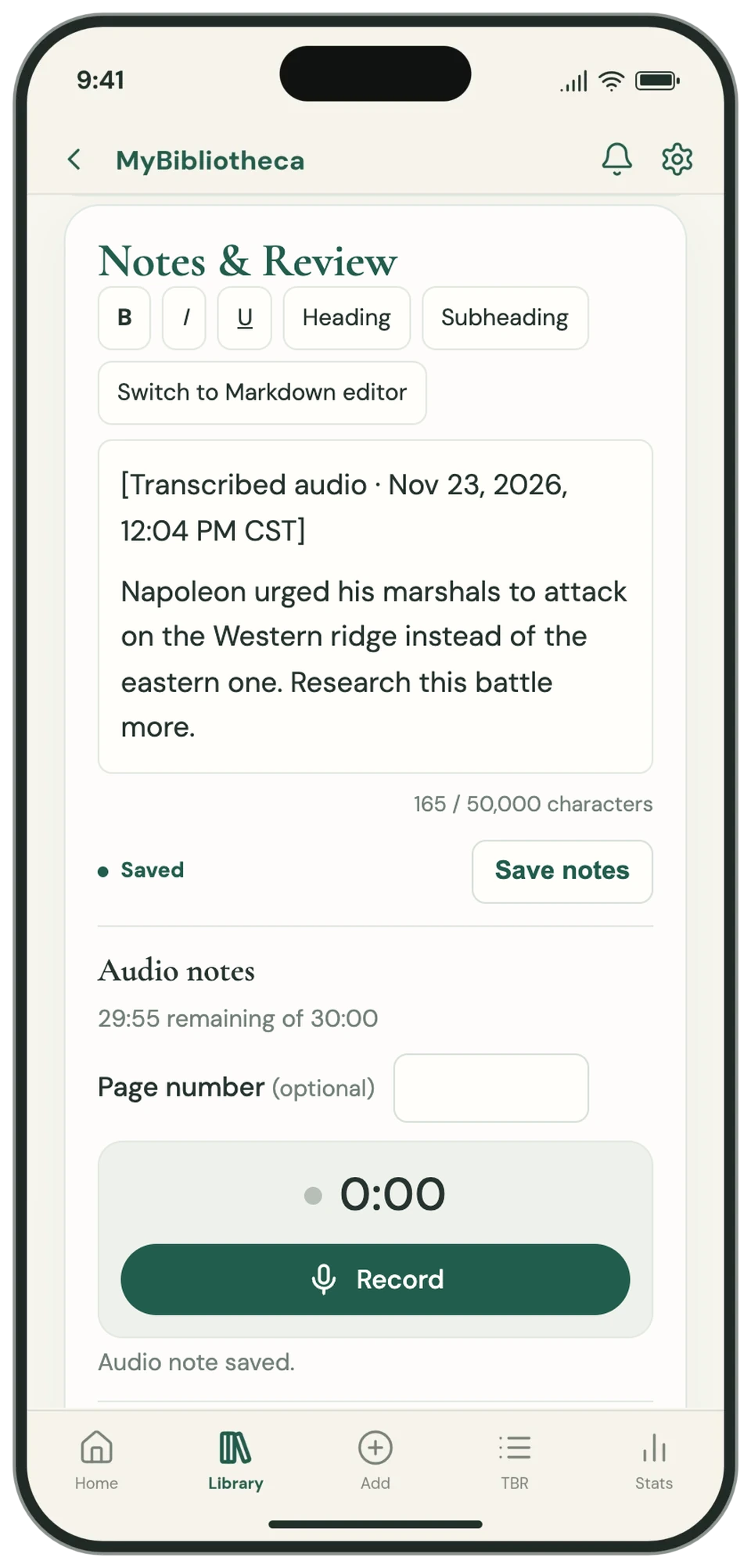
Notes and Review on a phone, showing a transcribed audio note added to the reading notes above the Audio notes recorder and its Record button.

Recording a note

Audio notes sit under Notes & Review on every book page. If the note is about a particular spot in the book, type the page number. Then press Record and talk. Your browser will ask for microphone access the first time.

There is a pause button, so you can stop to think without ending the note. Time you spend paused is not counted. When you are done, press Stop, then Save recording, or Discard if it was not worth keeping.

Each book has 30 minutes of audio notes in total, and the page shows how much you have left. Every saved note shows the date and time you recorded it, and you can play it back or delete it from the same list.

If the tab closes or your connection drops before you save, the recording stays on your device and is offered back to you the next time you open the book.

Turning it into text

Every saved note has a Transcribe button. Press it and the recording goes into a queue that handles one at a time. When yours is done you get a notification, and the text is added to that book's notes under a heading with the date, time and page number. After that it is ordinary text that you can edit. If the book is open when the transcript finishes, it shows up in your notes without a reload.

The transcribing is done by a small speech recognition model that runs on our own servers, so your audio is not sent to another company. Because the model is small, it makes mistakes, mostly with names and unusual words. Read the result before you rely on it.

Privacy

Audio notes are private to your account. Recordings are kept in private storage, and each time one is played the site checks that you are signed in as the person who saved it. They do not appear on a public profile. If you delete a note, it stops playing right away and the file is removed from storage shortly after. The privacy policy has the details.

Apps

Audio notes work in your browser now. Recording in the iOS and Android apps needs an app update that is not out yet, so for now, use the browser on your phone.

To try it, open a book in your library and look under Notes & Review. If you are new here, start your reading journal with whatever you are reading now.

Feature image: Unknown photographer, Man, two women and two children listening to phonograph, 1897. Library of Congress, Prints and Photographs Division. Public domain. Image and rights information.

10 MyBibliotheca Features Worth Finding Beyond the Basics

10 MyBibliotheca Features Worth Finding Beyond the Basics

11 minutes read

The November feature roundup covered the big parts of MyBibliotheca. This time I want to open the drawers. These ten smaller features are useful precisely because they solve particular reading problems: a forgotten book, a late-night session, a highlight that will not match its edition. Each heading has a stable link you can save or share.

  1. The books waiting for you
  2. A TBR order you control
  3. A streak that understands your timezone
  4. Book spans on the month calendar
  5. The books behind a heatmap day
  6. A recap card made in your browser
  7. Manual matching for Readwise books
  8. KOReader highlights that wait for Wi-Fi
  9. A book's highlights as a file
  10. A CSV backup of your reading history

1. The books waiting for you

A TBR can become a parking lot. In My TBR, Waiting for you brings back a few unread books that have been there at least 30 days. Books marked Up next and books by authors you have rated highly can appear first. A smaller reminder appears on the dashboard when there is something to revisit.

I find this more useful than a generic “you have 240 unread books” number. Imagine adding a novel in August because you loved its author's previous book, then forgetting it by November. This view gives that novel another chance without treating every old TBR entry as equally urgent. It does not decide for you; it simply puts a few candidates back in sight. Learn how My TBR works.

2. A TBR order you control

If you already know what is next, set My TBR's sort to Manual order. On desktop, drag a book by its handle. On a phone or with a keyboard, use Move up and Move down on its card. The order is one shared queue for unread books. Custom lists and filters show views of that queue, rather than keeping separate hidden orders.

That detail matters when you make a “winter reads” list and later move one book to the top of your main TBR. You will see the same relative order wherever that book appears. Use lists to narrow the view and the manual queue to express priority. If you want a surprise instead, Pick my next book respects the filters you have set. See the TBR controls.

3. A streak that understands your timezone

Reading at 11:45 p.m. should land on the day you actually read. In Settings, you can choose your account timezone; MyBibliotheca uses it when assigning late-night sessions to calendar days. A day counts toward a streak when it has a dated reading log with pages, minutes, or both.

There is also a way to carry in a streak from before you joined. During onboarding, enter its length and say whether you have read today. You can change that starting streak later in Settings. It remains separate from real sessions, so clearing it will not erase logged pages or minutes. This is useful when switching journals mid-habit, and it keeps the origin of the number clear. Read the streak and timezone guide.

4. Book spans on the month calendar

The month view in Stats does more than mark finished books. It can show a colored bar from a book's start date to its finish date, or through today if the book is still in progress. Arrows at the ends tell you when the span continues outside the visible month. Covers mark starts, finishes, and DNFs, while a dot marks a day with logged reading.

This is the view I would use to remember how a book fit into a month. A long fantasy novel might stretch across three weeks beside two short books finished in an afternoon. Choose a day to see its books, then open a book's page for the details. Dates you enter or import power the spans; the calendar does not invent a start date from a finish date. Explore the reading calendar.

5. The books behind a heatmap day

The dashboard's year heatmap is an overview, but each past day can tell a smaller story. Hover or tap a day to see its page and minute totals and up to four books from that day's reading. If more books were involved, the tooltip shows how many others there were.

A dark square can mean a long afternoon with one book or a few short sessions across several books. The day detail gives the color some context without sending you to a separate report. Future dates do not respond, and the view reflects sessions you actually logged. If you missed a day in your journal, add its session to make the history more complete. Learn about logging sessions.

6. A recap card made in your browser

A finished book can become its own recap card. For a broader look, make a card for this month, this year, or all time. You can choose which totals to show, including books finished, pages, listening minutes, and a reading streak, then choose a style and download a PNG.

The privacy detail is easy to miss: the image is composed in your browser. MyBibliotheca does not upload or save the generated card. You decide whether to keep it, send it to a friend, or post it elsewhere. A finish date and rating make a one-book card more complete, but sharing is always your choice. See how to make a reading recap.

7. Manual matching for Readwise books

Readwise can bring your saved highlights and notes into MyBibliotheca, but imported records do not automatically create library books. An automatic link needs one matching title and author, ignoring case and extra spaces, or one matching title when the Readwise record has no author. Covers, ISBNs, and fuzzy guesses are not used for this match.

That restraint is helpful when you own two editions of the same title. If a record cannot be matched safely, open Books waiting to be matched in Settings. Choose the right library book and confirm the link, or leave it unmatched for now. Linked annotations appear on the book page; the Readwise originals remain in Readwise, and syncing is one-way. Readwise requires its own account and access token. Read the matching guide.

8. KOReader highlights that wait for Wi-Fi

The separate MyBibliotheca highlights plugin for KOReader can send annotations directly, without Readwise. Its Auto-push highlights setting is off by default. When you turn it on and the device is online, the plugin waits until you have gone ten seconds without editing or turning a page, then batches the changes. Offline changes stay pending and can upload after you reconnect with the book open or reopen it online.

That pause makes sense during a note-heavy chapter: a sentence you are still editing should not trigger an upload on every keystroke. A failed upload retries, and Send this book's highlights gives you a manual retry. Closed books are not uploaded in the background, so check the plugin when an annotation seems missing. It uses dedicated KOReader sync credentials, not your website password. Follow the KOReader highlights guide.

9. A book's highlights as a file

On a library book's page, you can download its highlights and notes as Markdown or plain text. The file includes the book title and author, your book notes, and linked annotations from Readwise, KOReader, and manual entries. That gives you a portable, readable copy focused on one book.

I would use it after finishing a book I expect to revisit: save the text beside a personal essay draft, or search it later without opening the app. The export contains the material linked to that book, so check an unmatched Readwise or KOReader record before assuming it is absent. Learn about linking Readwise highlights and KOReader notes.

10. A CSV backup of your reading history

The book-level text export is for passages. The broader Download my data (CSV) control in Settings is for your reading record. It includes your profile, library books, statuses, ratings, notes, start and finish dates, and reading logs. It does not include your password or login tokens. The file is generated when you request it and is not saved as an export on MyBibliotheca's servers.

A backup is especially useful before a large import, a cleanup, or a move to another system. Store it somewhere private because it may contain the same candid notes you would keep in a paper journal. Follow the data export guide.

These are the details that make a reading journal feel more personal to me. If one caught your eye, use its section link to come back later, or explore MyBibliotheca and try it with a book you already know.

Feature image: Jean-Baptiste-Camille Corot, Woman Reading in the Studio, c. 1868. National Gallery of Art. The museum identifies the image as free and in the public domain. Artwork and rights information.
November Feature Roundup: 10 of My Favorite Features on MyBibliotheca

November Feature Roundup: 10 of My Favorite Features on MyBibliotheca

9 minutes read

November has been a good month to step back and look at what MyBibliotheca can do beyond keeping a list of finished books. These are ten of my favorite features, from the everyday habits that make a reading journal useful to a few places to discover something new. Each heading has its own link, so you can return to the feature that interests you.

  1. Bring your library with you
  2. Organize your shelves and TBR
  3. Log reading in your own units
  4. See the shape of your reading
  5. Keep a private reading journal
  6. Practice words you discover
  7. Make a book tier list
  8. Connect KOReader
  9. Explore advance reader copies
  10. Meet authors in The Commons

1. Bring your library with you

Starting a new reading journal should not mean entering every old book again. MyBibliotheca accepts CSV exports from Goodreads, StoryGraph, and other reading apps. You can review the detected columns and choose what to bring in before the import adds books. Statuses, ratings, notes, and reading dates can travel with the books when they are present in your file.

I like this because an old library is more than a set of titles. The dates and little notes are often the parts that make it yours. See the library import guide if you are moving an existing collection.

2. Organize your shelves and TBR

Once books are in your library, you can give them shelves and tags, keep track of series, and make TBR lists for different moods or plans. The TBR page also has a random pick when choosing the next book starts to feel like its own project.

This is one of those quiet features that saves time later. A shelf for borrowed books, a list for short winter reads, and a tag for a favorite setting can coexist without forcing one rigid filing system. Explore the library features.

3. Log reading in your own units

You can record page progress, a percentage, or audiobook minutes. Reading sessions give the calendar and stats something more useful than a single finished date. On an ebook, you can also enter the total shown by your e-reader. MyBibliotheca keeps the position you see on your device and converts new sessions to the comparable print page count for stats, provided that book has a print page count too.

That last detail is particularly helpful when changing font size turns a 700-page paperback into 1,700 e-reader pages. It is optional, applies to ebooks with a total, and does not rewrite older sessions. Read the e-reader page count guide or learn how to log progress.

4. See the shape of your reading

The stats bring together pages, listening minutes, sessions, streaks, genres, authors, formats, and ratings. A calendar makes the daily rhythm visible, while longer views help answer questions like whether you have been reading more audio lately or which authors keep returning to your shelf.

I enjoy stats most when they prompt a memory rather than a target. A busy week with ten minutes of listening still belongs in your reading story. The numbers come from the sessions you log, so they are most meaningful when you record progress in a way that works for you. See the reading and stats overview.

5. Keep a private reading journal

A rating rarely explains why a book stayed with you. Each book can hold private notes and reviews, with rich text for headings, emphasis, and the passage or thought you want to find again. The editor saves as you write and shows its save status.

My favorite use is a short note at the moment something clicks: a character decision, a question, or the sentence that made me stop. It need not be a polished review. The notes are private, even if you choose to share other parts of your reading life. See the reading journal feature.

6. Practice words you discover

If a word in a book catches your attention, MyBibliotheca can turn it into a vocabulary card. Single-word highlights can come from manual entries, Readwise, or KOReader. You can reveal an English definition and any available examples or synonyms, then choose Again, Hard, or Good to schedule another review.

It is a small bridge between noticing a word and actually remembering it. I like that the practice begins with language I met in a real book, rather than an unrelated word list. See vocabulary practice.

7. Make a book tier list

Sometimes a ranking says more than five stars. The tier list maker lets you arrange books from your library or the catalogue into tiers and change the names, colors, and order. You can keep a list private or share it as an image or link.

A tier list is especially fun for a series, a year's favorites, or an argument with yourself about which reread deserves the top spot. You can open the tier list maker and start with the books that matter to you.

8. Connect KOReader

Readers using KOReader can sync reading progress and send highlights and notes to MyBibliotheca. That cuts down on retyping and lets a session on your device become part of the same book history as your manual logs. If you have set an e-reader page total for an ebook, synced page changes use that total for the stats conversion too.

This is a feature I would set up once and then let run in the background. The KOReader progress sync guide explains the connection, and the highlights guide covers annotations.

9. Explore advance reader copies

The ARC gallery is a place to find advance reader copies shared by authors. You can browse public listings and request books that are open to readers. Approved copies can be EPUB, PDF, or audiobook, depending on the listing. Reviews are optional.

It is a different kind of discovery from browsing your own backlog: a chance to meet a book before release and, if you want, share thoughtful feedback with its author. Authors control who receives a private copy. Browse the ARC gallery.

10. Meet authors in The Commons

The Commons gives authors a place to present their profiles and catalogue books. A profile can include links, genres, release information, and books, so readers can move from a title to the person who wrote it and explore more of their work.

I like ending the list here because a personal library is also a route to discovery. The Commons adds an author-focused corner to MyBibliotheca without turning your private notes into a public feed. Visit The Commons.

Those are my ten picks for November. If you are new here, explore MyBibliotheca and start with the feature that fits your reading right now. I plan to return each month with another roundup and a fresh set of links to explore.

Feature image: Daniel Marot the Elder, Interior of a Library, published 1703 or 1712. The Metropolitan Museum of Art, Open Access (public domain). Artwork and rights information.